SustainabilityⅠ. Providing value to society (or reducing damage to social capital)Provide eco-friendly buildings for the next generation
Related SDGs
Themes
- 8.Improve the environmental performance of Company-owned buildings
- 9.Reduce the environmental impact of buildings over their life cycle
- 10.Coexist with the natural environment
- 11.Visualize and disclose the environmental performance of our buildings and the environmental value they provide to society
Opportunities and Risks
| Opportunities |
|
|---|---|
| Risks |
|
| Existing Measures |
|
| Measures to Be Implemented |
|
KPIs and Results
*Scroll horizontally to see more.
| KPIs | Target year | Target figures | Fiscal 2022 results | Fiscal 2023 results | Fiscal 2024 results | ||||||||
|---|---|---|---|---|---|---|---|---|---|---|---|---|---|
| Reduction of GHG emissions (Scope 1, 2) Scope Reduction of GHG emissions (Scope 1, 2) Scope *Scroll horizontally to see more.
|
1) Fiscal 2030 2) Fiscal 2050 |
1) 75% reduction or more (compared with fiscal 2019) 2) Net-zero emissions |
71% reduction (compared with fiscal 2019) | 74% reduction (compared with fiscal 2019) | 79% reduction (compared with fiscal 2019) | ||||||||
| Reduction of GHG emissions (Scope 3) Scope Reduction of GHG emissions (Scope 3) Scope *Scroll horizontally to see more.
|
1) Fiscal 2030 2) Fiscal 2050 |
1) 30% reduction or more (compared with fiscal 2019) 2) Net-zero emissions |
22% reduction (compared with fiscal 2019) | 38% increase (compared with fiscal 2019) | 17% reduction (compared with fiscal 2019) | ||||||||
| Reduction in total energy use per basic unit Scope Reduction in total energy use per basic unit Scope *Scroll horizontally to see more.
|
Every fiscal year until fiscal 2030 | 1% year-on-year decrease in the basic unit each fiscal year | 0.6% reduction (compared with fiscal 2022) | 0.2% increase (compared with fiscal 2022) | 2% increase (compared with fiscal 2023) | ||||||||
| Electricity derived from renewable sources (according to RE100) Scope Electricity derived from renewable sources (according to RE100) Scope *Scroll horizontally to see more.
|
Fiscal 2025 | 100% | 94% | 98% | 99.9% | ||||||||
| Percentage of office buildings with environment-related certifications Scope Percentage of office buildings with environment-related certifications Scope *Scroll horizontally to see more.
|
Every fiscal year | 100% | — | 100% Midosuji Daibiru Building receives CASBEE Osaka Mirai S rank certification |
No relevant buildings | ||||||||
| Percentage of buildings with ZEB Oriented certification or higher Scope Percentage of buildings with ZEB Oriented certification or higher Scope *Scroll horizontally to see more.
|
Every fiscal year | 100% | — | 100% Midosuji Daibiru Building receives ZEB-Oriented certification |
No relevant buildings (Reference: ZEB Oriented certification acquired upon renovation of Yodoyabashi Daibiru Building) | ||||||||
| Amount of waste generated per basic unit Scope Amount of waste generated per basic unit Scope *Scroll horizontally to see more.
|
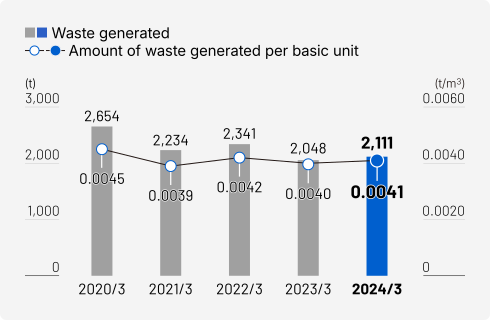
Fiscal 2030 | 20% reduction or more (compared with fiscal 2019) | 11% reduction (compared with fiscal 2019) | 9% reduction (compared with fiscal 2019) | 11% reduction (compared with fiscal 2019) | ||||||||
| Recycling rate Scope Recycling rate Scope *Scroll horizontally to see more.
|
Fiscal 2030 | 75% or higher | 58% | 57% | 57% | ||||||||
| Promotion of domestically produced and certified wood use Scope Promotion of domestically produced and certified wood use Scope *Scroll horizontally to see more.
|
— | — | Conducted research on the use of domestically produced and certified wood | Some of the furniture made using domestic wood has been installed in the renovated head office and the Midosuji Daibiru Building | Continuing investigation into adoption for a specific project | ||||||||
Environmental initiatives
Addressing climate change and forming a circular society
The Daibiru Group's commitment to sustainability is one of our most important missions. Guided by our corporate principles and adhering to our Group Code of Conduct, we aim for sustainable development with society through our corporate activities.
Reduction of GHG emissions
The Daibiru Group has set a long-term goal of achieving netzero GHG emissions by 2050, as well as medium-term goals for 2030 of reducing Scope 1 and Scope 2 emissions by 75% and Scope 3 emissions by 30% compared with fiscal 2019.
Efforts toward achieving carbon neutrality

Reductions in energy consumption
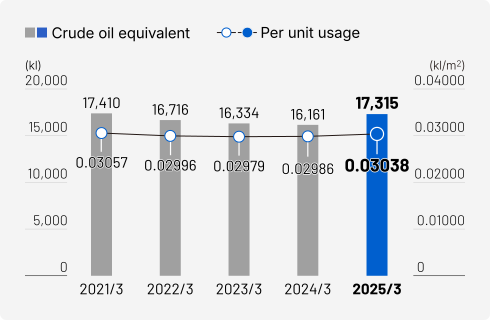
While the energy consumption in our Company-owned buildings*1 fluctuates annually with changes in the operational floor area, our efforts to reduce environmental impact have led to a downward trend in per-unit energy use.
- *1Refers to the 29 Company-owned office and commercial buildings that are subject to the Energy Conservation Act.
Reductions in energy consumption
Adoption of emissions-free electricity, and membership in RE100
Since April 2022, Daibiru has steadily introduced emissions-free power with tracking information*2, and aims for all of the electricity consumed at company’s buildings*3 to be compliant with RE100 by fiscal 2025. Furthermore, because the electricity consumed by tenants in those buildings’ offices and stores will have zero CO2 emissions, it will lead to an enhancement in their corporate environmental evaluation.
- *2Electricity that is substantially derived from renewable energy sources using Non-Fossil Certificates. With tracking information: Electricity utilizing Non-Fossil ertificates with tracking information indicating the place of power generation.
- *3Excluding buildings which are scheduled to be rebuilt or those for which the Company has not concluded the power purchase contract.
Promotion of waste generation volume control and recycling
Various types of waste are generated during the construction and demolition phases of buildings. At Daibiru, we ensure the proper management and disposal of hazardous materials and substances that could lead to environmental pollution in accordance with legal regulations. Additionally, we recover and reuse materials such as concrete debris and refrigerants like lithium bromide used in air conditioning systems. During the Midosuji Daibiru Building redevelopment, the existing structure was repurposed as a retaining wall for soil during excavation.
Even as buildings become operational, we continue to reduce waste, establishing systems for sorting and collecting garbage to promote recycling.
Waste generation figures